
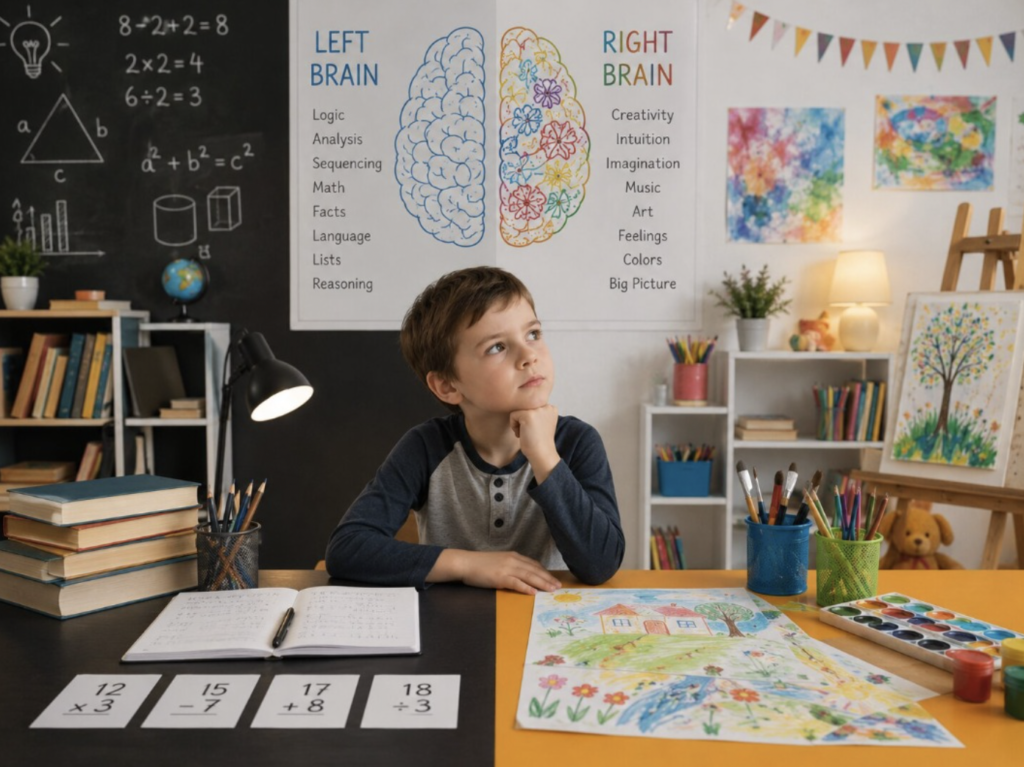
Your child aces every spelling test but freezes when asked to draw a picture. Or they fill sketchbooks with intricate worlds but can’t seem to remember their times tables no matter how many times you drill them. Neither scenario means something is wrong. It often means their brain has a preferred way of processing the world.
Understanding whether your child leans left-brained or right-brained can change how you interpret their behavior, how you help them with homework, and how you talk to their teacher about what they need. If you’re curious about your own thinking style first — which actually helps a lot with this — a free left or right brain test takes about four minutes. Then the signs below will feel a lot more concrete.
Why Do Some Kids Seem Wired So Differently?
Because they are — and the differences surface early. Children display recognizable cognitive tendencies from a surprisingly young age, and those tendencies shape how they take in information, relate to other people, and engage with learning long before anyone starts labeling them.
Research measuring brain activity in young children shows that the right brain is dominant during the first three years of life. The left brain’s analytical functions — language, numeracy, sequential reasoning — don’t fully mature until around age seven. This means most young children are naturally more intuitive, visual, and emotionally driven in their early years, and some maintain that as their dominant cognitive style even as analytical abilities develop.
Here’s what this looks like in a real household: two siblings, same parents, same school. One lines up their toys by size, follows the rules of a board game precisely, and can tell you exactly how many days until their birthday. The other loses track of the rules completely but invents an entirely new game halfway through, complete with its own backstory and characters. Neither child is more intelligent. They just need different things from the adults around them.
This isn’t just an observation parents make — NIH-published research on cognitive development in school-age children consistently shows that children vary significantly in how their brains process sequential versus holistic information, and that matching instruction to cognitive style improves learning outcomes.
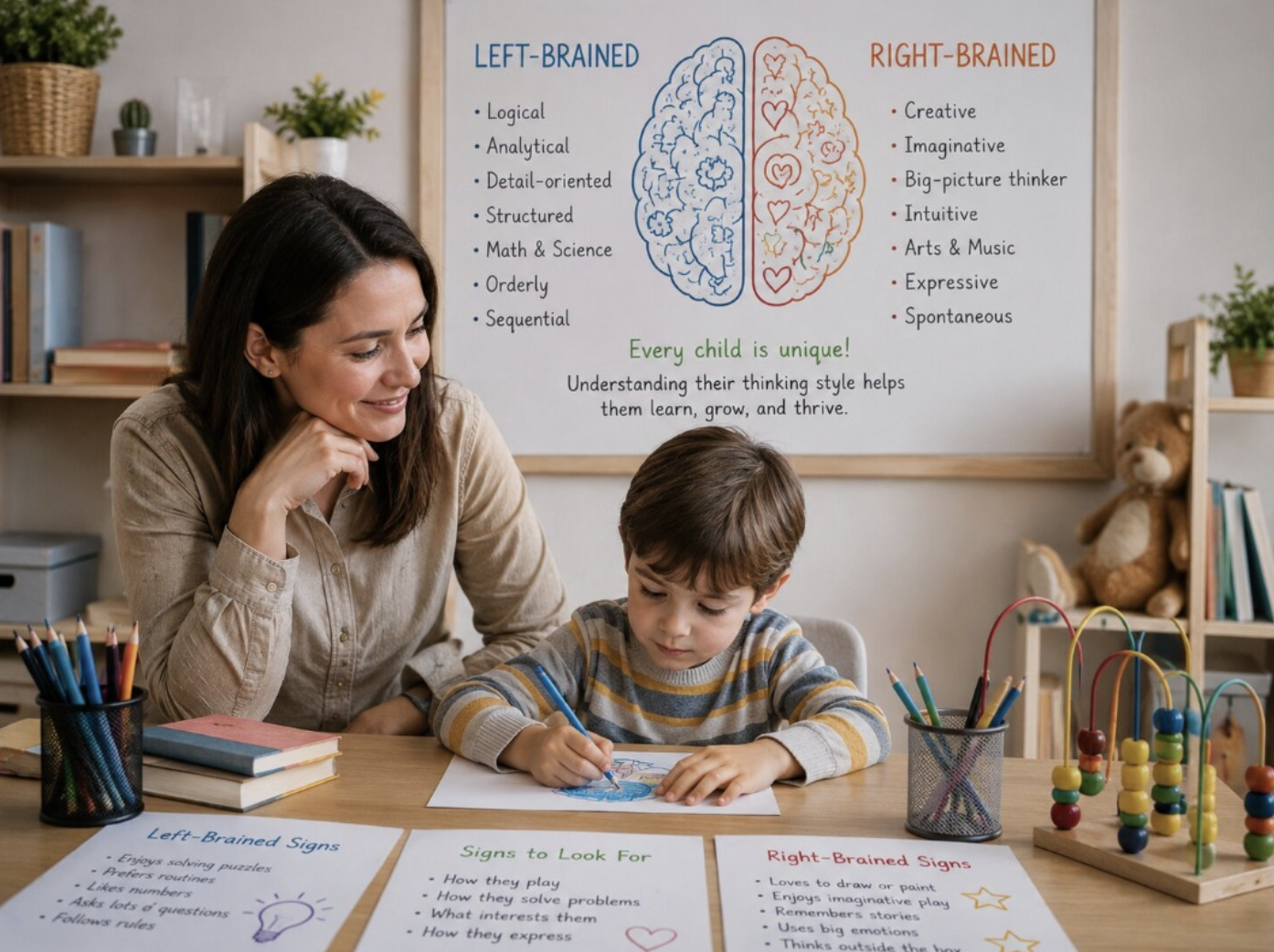
Signs of a Left-Brained Child
Left-brained children are often organized, rule-oriented, and most comfortable when they know exactly what’s expected. Their cognitive style frequently makes them easier to manage in traditional school settings — but it can also make them genuinely distressed when plans change unexpectedly.
At School
Left-brained children often excel at reading, spelling, and math — especially when material is presented step-by-step. They follow directions well, prefer structured tasks over open-ended projects, and tend to work independently rather than in groups. They’re often the kids who raise their hand to correct the teacher on a small factual detail.
At Home
These children often like predictable routines — the same breakfast, the same bedtime sequence, the same spot on the couch. They may get genuinely upset when plans change last-minute. Their rooms are often tidy, their homework done without being asked, and their bookshelves organized in a system only they fully understand.
Behaviorally
Left-brained children tend to think before they speak, prefer one-on-one conversation over group dynamics, and express themselves more clearly in writing than out loud in a crowd. They’re often described by teachers as “focused” and “reliable” — and by their parents as “a little too serious sometimes.”
A recognizable scenario: a left-brained eight-year-old who, when asked to write a creative story, immediately wants to know how long it needs to be, what format to use, and whether there are points for spelling. The creativity isn’t the problem — the open-endedness is.
Here’s a side-by-side look at how the two thinking styles typically come through in children:
| Area | Left-Brained Child | Right-Brained Child |
| Learning style | Sequential, structured, step-by-step | Visual, holistic, story-driven |
| School strengths | Reading, spelling, math facts | Art, storytelling, big-picture concepts |
| Challenges | Open-ended tasks, unexpected changes | Rote memorization, rigid deadlines |
| Social style | Independent, prefers one-on-one | Group-oriented, emotionally attuned |
| Home behavior | Routine-driven, organized | Spontaneous, imaginative, scattered |
Signs of a Right-Brained Child
If a left-brained child wants to know the rules before they play, a right-brained child has already invented a completely different game. They’re imaginative, emotionally perceptive, and far more interested in the big picture than in any individual detail — which makes traditional school a genuinely difficult fit for many of them.
At School
Right-brained children often struggle with rote memorization, sequential instructions, and timed tests. They may read well below grade level despite being clearly intelligent, or ace a verbal discussion of a topic while bombing the written quiz on the same material. According to education researcher Katharine Beals, PhD, these children are often misread by traditional school systems that favor sequential, language-based instruction.
At Home
Right-brained children are often imaginative storytellers, emotionally sensitive, and deeply attuned to the people around them. Their rooms lean toward creative chaos — projects half-finished, ideas everywhere, nothing where it “should” be. They resist rigid schedules but can focus intensely for hours on something that genuinely interests them.
Behaviorally
These children often think out loud, process emotions externally, and have a strong sense of fairness and empathy. They’re the ones who cry at movies, remember the emotional details of an event years later, and notice when someone in the room is upset before any adult does.
If your child has ever come home from school feeling stupid — and you knew they weren’t — there’s a good chance the format, not the material, was the problem.
Here’s what this actually looks like: a right-brained child who can’t recall the steps of long division on a worksheet but explains, perfectly and unprompted, exactly how the same concept works using a story about sharing pizza with friends. The understanding is there — the format was wrong.
How Can You Support a Left-Brained or Right-Brained Child at Home?
No parenting adjustment fixes everything. But a few well-aimed ones can change how a child experiences their own ability — which changes quite a lot.
For Left-Brained Children
Give them clear expectations and advance notice of changes. When assigning tasks, break them into steps rather than describing the goal and leaving the method open. Celebrate their reliability and precision — these aren’t “boring” traits, they’re genuine cognitive strengths. When they seem rigid, it’s usually anxiety about unpredictability, not stubbornness.
For Right-Brained Children
Connect learning to meaning before drilling facts. Before helping with homework, give them the big picture first: “Here’s what this is about and why it matters” — then the details. Use stories, visuals, and real-world examples wherever possible. Structure their environment rather than their schedule — a consistent physical workspace often works better than a rigid time routine. When they seem scattered, it’s usually that the input isn’t connecting, not that they’re not trying.
At School
For either type, the most useful thing a parent can do is help teachers understand how their child processes information — not just what they struggle with. “She needs to understand why before she can memorize how” is more actionable for a teacher than “she has trouble focusing.”
The specifics matter less than the principle: your child doesn’t need a different brain. They need adults who understand the one they have.
NIH-published research on schooling and neurocognitive development confirms that learning environments that account for cognitive style differences produce noticeably better results than one-size-fits-all instruction.
Does Your Own Brain Type Affect How You Parent?
More than most parents realize. When a left-brained parent raises a right-brained child — or vice versa — the same friction that appears between analytical and creative adults in relationships tends to come through between parent and child, just with a significant power imbalance added.
An analytical parent whose child can’t explain their reasoning often reads that as carelessness. A creative parent whose child wants a detailed plan before trying anything new often reads that as being afraid or rigid. In both cases, the parent is interpreting their child’s cognitive style through their own — and arriving at conclusions that usually aren’t accurate.
Understanding your own left-brained or right-brained tendencies doesn’t just help you understand yourself. It helps you notice when you’re asking your child to think like you do, rather than supporting how they actually think. A right-brained parent who finally understands that their analytical child isn’t “being difficult” — they genuinely need more information before they can move — often describes it as one of the most useful parenting realizations they’ve had.
The mismatch isn’t the problem. Not knowing about it is.
How Do You Find Out Which Type Your Child Is?
The fastest starting point is to take the assessment yourself first — not because your child will necessarily match you, but because understanding your own cognitive style gives you a clearer baseline for observing theirs without your own defaults getting in the way.
A free left or right brain test measures your response patterns across analytical and creative dimensions in about four minutes. Once you have your own result, the signs in the sections above will feel less like a general checklist and more like a specific lens. Older children — roughly ten and up — can also take it directly for a concrete starting point of their own.
The goal isn’t to label your child. It’s to understand them a little more accurately than you did before.
Left-brained and right-brained tendencies in children are real — and they show up in ways parents can observe every day. The child who needs the rules before they play and the child who rewrites the rules halfway through aren’t more or less capable than each other. They’re processing the world differently, and they need different things to thrive.
Recognizing your child’s dominant cognitive style changes what you notice, how you respond, and how you advocate for them at school. It doesn’t put them in a box — it gives you a better map of the box they’re already in, so you can help them find the door.
References
- National Institutes of Health / NCBI. Cognitive Development in School-Age Children. 2023.
- National Institutes of Health / PMC. An Envisioned Bridge: Schooling as a Neurocognitive Developmental Institution. 2015.
- Lumen Learning — Lifespan Development. Brain Maturation: Growth in the Hemispheres. 2023.
- Beals, K., PhD. Scholastic. Left Brain, Left Behind?. 2018.
- University of Utah Health. Researchers Debunk Myth of “Right-brain” and “Left-brain” Personality Traits. 2013.
Frequently Asked Questions
What are the main signs of a right-brained child?
Right-brained children tend to be creative, emotionally perceptive, and drawn to the big picture before the details. They often struggle with rote memorization and timed tests despite being clearly intelligent, and may read below grade level while excelling at verbal discussion or creative storytelling. At home, they’re often imaginative, emotionally sensitive, and deeply attuned to the people around them. Their rooms tend toward creative chaos, and they can focus intensely for hours on something that genuinely interests them while appearing scattered in structured environments.
Can a child be both left-brained and right-brained?
Yes — most children show tendencies from both types, with a natural lean toward one. The left/right brain framework describes a dominant cognitive style, not a fixed category. A child might be highly analytical in math while being emotionally intuitive in social situations, or excel at creative writing while needing structured routines at home. The goal isn’t to fit your child into one box, but to recognize their dominant tendencies so you can support them more effectively in both areas.
How can I help a right-brained child who struggles in school?
The most effective approach is to connect learning to meaning before drilling facts. Give your child the big picture first — what the concept is about and why it matters — before working through the details. Use stories, visuals, and real-world examples wherever possible, and help their teacher understand how they process information rather than just what they find difficult. Right-brained children often understand material deeply but perform poorly in formats — timed tests, written worksheets — that don’t match how they process information. Changing the format often changes the result.
What if my child thinks completely differently than I do?
This is more common than most parents expect — and it’s worth knowing about early. When a left-brained parent raises a right-brained child or vice versa, the same friction that appears between analytical and creative adults in relationships tends to come through between parent and child. An analytical parent may read a creative child’s behavior as careless or unfocused. A creative parent may read an analytical child’s need for rules and routines as rigid or anxious. Understanding your own cognitive style helps you recognize when you’re expecting your child to think like you do — and adjust your support accordingly.
How can I find out my child’s thinking style?
The most practical starting point is to take a structured self-assessment yourself first. Understanding your own cognitive tendencies helps you observe your child’s with less of your own defaults getting in the way. A free left or right brain test measures your response patterns across analytical and creative dimensions in about four minutes. Older children — roughly ten and up — can take it directly. For younger children, the signs described in this article are your most reliable guide: watch how they approach problems, structure their environment, handle unexpected changes, and connect with other people.






























10 Comments on "Is Your Child Left-Brained or Right-Brained? Signs Every Parent Should Know"
Would you like to share your thoughts?
Your email address will not be published. Required fields are marked *