
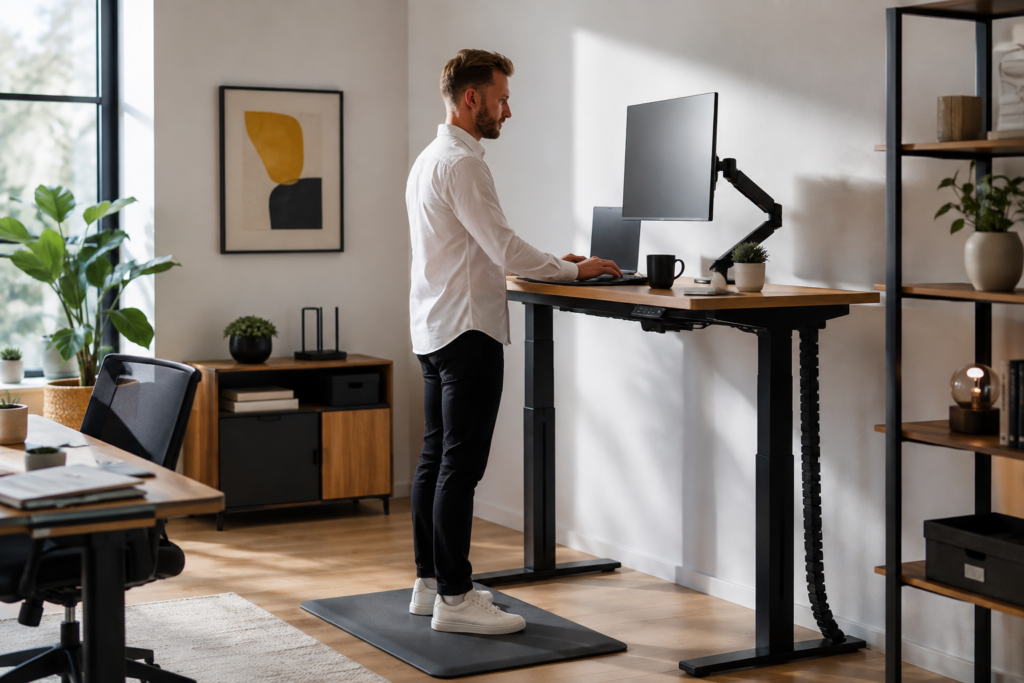
Standing desks were a natural choice for at-home jobs as it became evident that sitting around the house at a work computer for most of the day made people more unhappy and unhealthy than even working at home used to be. A table with height adjustment is probably the easiest solution. Since there is no need to walk to the meeting room or grab coffee, the remote workers actually spend even more hours a day at their desks. A desk that allows you to switch between sitting and standing at will will bring some of that long, leisurely walk back into the day, which is precisely why it is so attractive as a solution.
It seems this trend is not entirely driven by a health trend, rather it is a reaction from individuals when they see how their backaches and sluggishness have become more pronounced by noon if they just stay the same, working at their desks on the sofas or beds as it were.
What Actually Changed When Work Moved Home
The office contained a natural movement that nobody valued until it was gone. A colleague’s question prompted you to walk across the floor, you got up and went to the printer, then you remained in the kitchen till the kettle was boiled. All these minor interruptions resulted in you being on your feet for real throughout the day.
That is just what the standing desk was created for. It is not that standing alone is magical; standing upright for about eight hours leads to its share of troubles. The point is changing postures and a desk that is height-adjustable gives you that possibility without being distracted by your tasks. So, for example, you raise it after a snack break when a slump starts taking over, get back to the low desk when exhausted and continue using the keyboard all the time.
The work-from-home employees usually spend much more time at their desk compared with office people, as there is no longer a physical demarcation line separating home life and work life. Per the industry surveys about work habits, people tend to sit in front of the screen for a longer duration of time if they are working from home, and because of this, the need for a desk supporting different postures is getting stronger, not weaker. Every hour you choose not to change your seating position the less you are getting out of a static desk.
Do Standing Desks Actually Help, or Is It Hype
I would honestly say they are very useful for certain things but not for others. From workplace studies of standing and sitting, it seems alternating between the two is beneficial for lessening lower back pain and improving alertness around 2 PM, which are among the most commonly mentioned issues of remote workers. Stand-up desks But aren’t proven to consume enough calories to be a replacement for actual exercise, so a buyer would be disillusioned if a stand-up desk is supposed to be a weight-loss device.
The actual advantage is comfort and maintaining concentration, not major health improvements. Most individuals complain about fewer complaints after work hours and have a bit more energy on an average day, and only this suffices to justify purchasing the stand up desk. The right approach is not to consider standing only as a goal but to see movement as the goal where the desk is the device that allows you small changes in positions very easily.
Besides these, there is one more thing no one tells you about, which is a change phase. The first week of increased standing seems tiring, your feet and calves complain and many of them simply stop the programme before the body adapts to the new activity. So, if you ease up on yourself by starting with 20 to 30 minutes of standing per time segment and go on gradually, you will be prevented from feeling discouragement during the early stages when expensive desks get put in their sitting positions permanently.
What to Look For and What It Costs
There’s a very nice division for different prices. Manual crank is the cheapest, electric single-motor desks are in the mid-range, and the most expensive are the ones with dual-motor frame and memory functions. Electrical versions usually cost between 300 and 700 francs according frame and desktop quality. However, manual lifts are definitely the cheapest, but they require to raise the desk manually by yourself using hand crank. It is quite a struggle and people tend to forget it quickly after a couple of uses.
Actually, frame type is the most impactful thing when it comes to quality and performance. The dual-motor lifting frame moves smoothly without trembling at the height when you stand, which makes a big difference between the one you use every day and the one that will eventually be forgotten because every time when you type, the monitor will be shaking. Also take into account the weight carrying capacity and height range since the desk that does not allow you to reach the correct standing height where your elbows are bent at a right angle is useless for the taller or shorter people.
When you are comparing frames and desktops alongside the accessories that make the setup work, an anti-fatigue mat, a monitor arm, a cable tray, a shop like pandaloo.ch carries the range that lets you sort the whole standing setup in one place rather than piecing it together from separate sellers. The anti-fatigue mat in particular is worth budgeting for, because standing on a hard floor for long stretches causes exactly the foot and leg fatigue that drives people back into their chairs.
Who Benefits Most and Who Can Skip It
The desk is a great investment above all for people who spend a lot of time seated without taking breaks and who already have aching backs. The ones who benefit the most are developers writers analysts, etc. or those who work continuously at the screen for hours, because these people are the least likely to get up. Still, if your job already involves working around the house or taking calls while pacing, the idea is even less convincing.
However, if you have very little space you may have to think about your standing work desk differently. The standing desk has about a working footprint of 120 by 60 centimetres and the frame is a heavy and difficult piece to move compared to the simple table. Sometimes, instead of a large table or deskspace, renters or those in small accommodations get good results from desktop converters, which fit on existing desks and lift only the computer screen and keyboard. These desktop converters are generally less expensive and leave a free floor space for other things.






















0 Comments on "Why Standing Desks Are Becoming a Remote Work Staple"
Would you like to share your thoughts?
Your email address will not be published. Required fields are marked *