
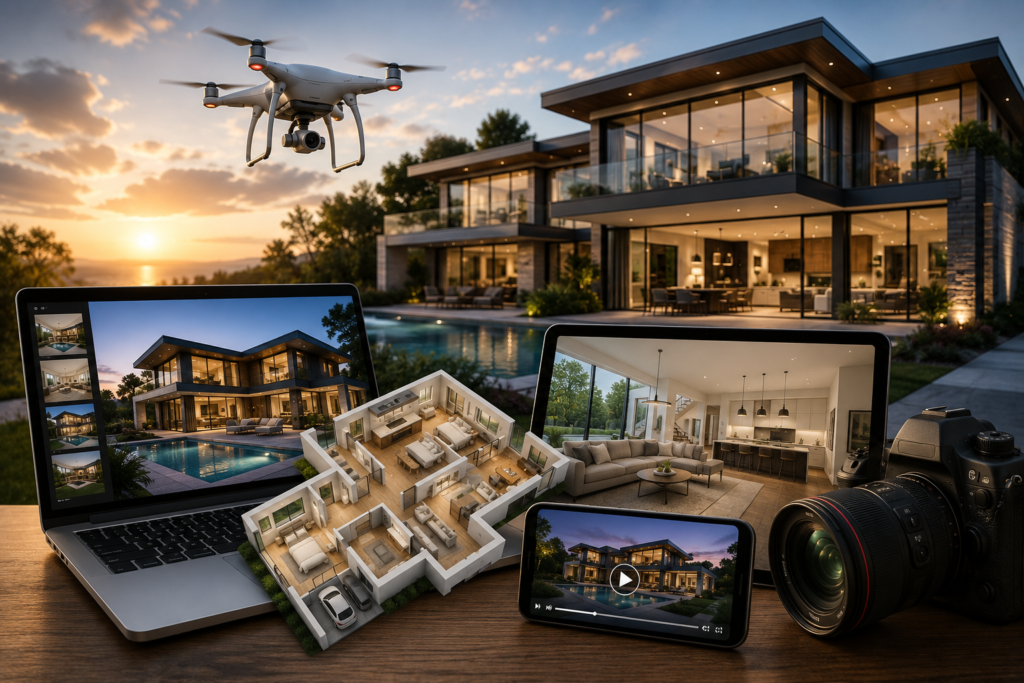
The first showing no longer happens at the property. It happens on a phone screen, days or weeks before a buyer ever picks up the phone. According to the 2025 NAR Technology Survey, 64% of realtors have adopted new technology to improve the client experience, and 75% use social media for business.
For 39% of agents, those social platforms are already producing their highest-quality leads. Visual marketing isn’t a bonus feature anymore. It’s where the transaction usually begins.
Buyer Behavior Changed First
The change didn’t start with technology. It started with buyer behavior and the tools followed. People look through hundreds of listings before they even call an agent. Most searches start on a phone or a search engine, not by phone.
Social platforms are discovery tools in their own right, not just somewhere to post a listing after the fact. More buyers also search from out of state or overseas, which pushes them toward any tools that allow them to evaluate a property remotely.
The result? Online search and mobile browsing have quietly rewritten the home-buying journey. Good photos are often what decide whether someone bothers exploring a listing at all. They’ve effectively become the first tour.
Photos Set the Tone Before Anyone Calls
Agents have adjusted their own standards to match how people shop now. Sharp imagery sets a property’s perceived value from the first click, well before an agent says a word. The NAR survey found that 45% of clients respond very positively to listings built around strong visuals and technology, and there’s a reason for that: photos act as a stand-in for the agent’s own competence. A tight gallery signals a higher level of service. A weak one can lose a buyer before the conversation even starts.
None of this replaces fundamentals, of course. Great photos get people through the door, but they won’t fix a mispriced listing or paper over a real structural problem.
Video Walkthroughs Draw Buyers
Buyers now expect video before they’ll even book a tour. Walkthrough videos do particularly well on Instagram Reels and TikTok, while YouTube still tends to host the longer, more detailed property tours. Video shows how rooms connect to each other in a way still photos cannot, which matters most to out-of-state or international buyers who can’t just swing by.
That shift shows up in the lead numbers: social platforms, largely powered by video, already generate 39% of agents’ top-tier leads. The catch is that video costs more to produce than photography does, and staying visible on social platforms requires a steady stream of new content. That’s a real ongoing commitment of time and budget, not a one-time expense.
Even smaller housing markets now follow the same visual-first standard. No matter which city the property is in, professionally presented home listings with high-quality photos and other visual assets help buyers evaluate properties before scheduling a tour.
Drone Footage for the Listings That Need It
Some properties need an aerial view to make their case. Waterfront homes need drone shots to show how close they actually sit to the water. Large estates need the altitude to capture the full scale of the land. New developments use drone footage to document construction progress. For listings like these, ground-level photos alone don’t cut it, which helps explain why 52% of realtors now use drone photography or video in their marketing. Aerial views also give buyers a sense of the surrounding neighborhood that a ground-level shot can’t.
It’s not a universal tool, though. Drone use depends on FAA rules, weather, and airspace restrictions, and a small starter home rarely benefits from an aerial shot the way a waterfront estate does.
Virtual Tours Give Listings an Edge
38% of realtors now use virtual tours, mostly for efficiency. A virtual walkthrough gives an out-of-town or international buyer a real sense of the space without requiring a flight or a long drive. It’s also the clearest example of why 66% of realtors cite time savings as their main reason for adopting new technology in the first place: by screening out buyers who aren’t seriously interested, agents free up time for the showings that actually matter.
Even so, virtual tours don’t replace in-person visits for everyone. Plenty of buyers, especially in the luxury market, still want to walk through a property more than once before they’ll commit.
Trust Builds Before the First Call
Trust in a listing and in the agent behind it usually forms before any conversation happens. Professional media signals preparation and market knowledge before a buyer says a word. Eighty-two percent of realtors report positive client responses to technology integration, and 45% call that response very positive. A polished listing suggests an agent who pays attention to detail, which matters most for buyers still deciding whether to reach out at all.
AI Is Doing the Grunt Work, Not the Creative Work
AI has turned into more of a productivity boost than a replacement for the people actually doing the work. Agents use it for virtual staging, image touch-ups, and quick floor plans. Forty-six percent of realtors now use AI-generated content for listing descriptions, and 41% use generative AI tools more broadly (think ChatGPT or Google Gemini) for communications and marketing copy. In fact, Houzeo, a home buying and selling website, has integrated ChatGPT into its IntelliList Studio to help home sellers and their agents generate compelling descriptions for their homes. About a third of agents (33%) describe the impact so far as moderately positive.
The tools raise real questions, too. Over-edited or unrealistic AI images can misrepresent a property, which risks buyer trust and, in some cases, legal exposure. Used well, AI supports the photographers and copywriters already doing the work. It doesn’t replace them, and treating it as a shortcut around good pricing, honest representation, and sound judgment tends to backfire.
What’s the Lesson for Real Estate Agents
None of these tools saves a listing that’s priced wrong or represented dishonestly, and none of them work in isolation. What they do is set the terms of the first impression, and increasingly, that impression forms before an agent ever picks up the phone. The listings that get noticed are the ones treating photos, video, and virtual tours as the actual start of the sales process, not an afterthought tacked onto a yard sign.




























3 Comments on "How Visual Content Is Transforming Real Estate Marketing in 2026"
Would you like to share your thoughts?
Your email address will not be published. Required fields are marked *