
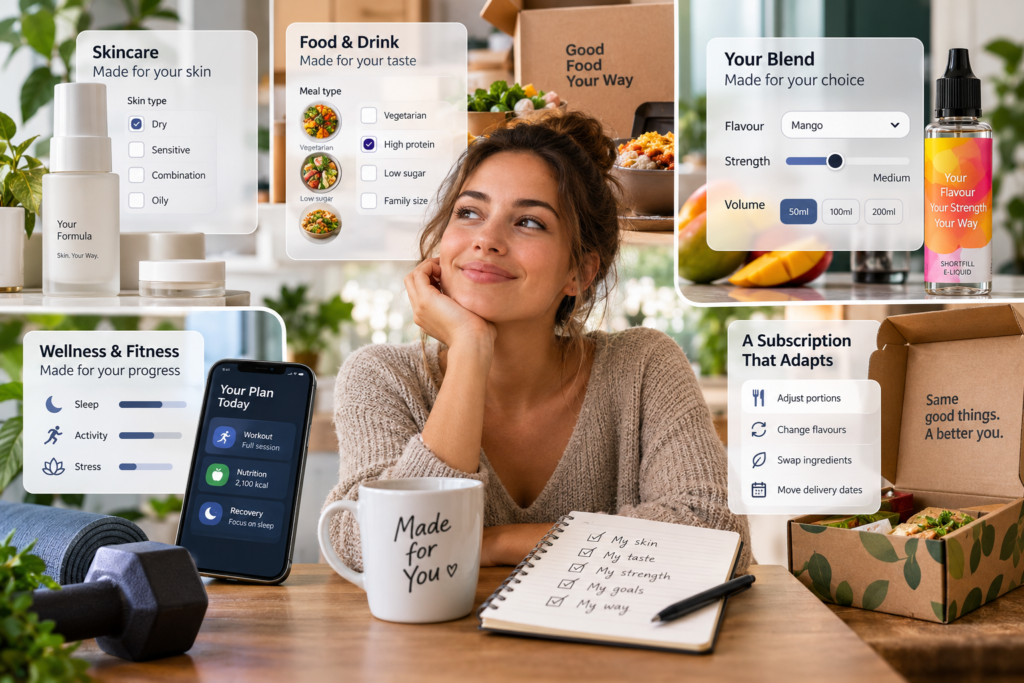
People choose products differently now, and personal fit plays a bigger part in that choice. Brands answer with options that match preferences down to smaller details, from flavour to strength to delivery method. This shows up across many categories, and it says something about what shoppers value today, well beyond the price on a label.
What Personalisation Signals to Buyers
“Made for you” used to mean a name printed on a label or a colour picked from a small chart. Now it can mean a formula built around someone’s skin type, a subscription box that adjusts each month, or a nicotine strength chosen to match daily use. Buyers read these signals as care, and they respond by staying loyal to brands that keep listening.
That loyalty builds slowly, and it depends on consistency more than novelty. A brand that offers choice once and then reverts to a single option loses the trust it built. So the promise of personal fit only holds when it stays part of how a company operates.
How Personalisation Plays Out Across Categories
Every category interprets personal fit differently, and the tools used to build that offer vary just as much. Some rely on quizzes, others on ingredient panels, and some on customer feedback collected over months. A few differ enough from one another that it’s worth walking through them one at a time.
Skincare and Personal Care
Skincare brands ask detailed questions about skin tone, sensitivity, and climate before recommending products. Some mix a formula on demand instead of pulling from fixed stock, adjusting active ingredient levels or leaving out fragrance to suit conditions such as dry skin or sensitivity to certain oils. Customers see this as proof that a brand pays attention to them specifically, and that attention keeps them coming back for their next order.
Food and Drink Subscriptions
Meal kits and coffee subscriptions now adjust portion sizes, spice or sugar levels, and roast profiles based on past orders. Each box reflects choices made weeks earlier, and that continuity keeps subscribers engaged, whether the change involves swapping a protein, cutting added sugar, or moving delivery days around a household’s schedule. Cancelling starts to feel like losing a service built around them, since a generic box won’t fit once someone has grown used to one shaped by their own habits.
Personal Consumables and Everyday Blends
Many consumable products now let buyers set their own strength, flavour, and volume instead of choosing from a short, fixed list. Coffee concentrates, flavoured waters, and supplement blends follow this pattern, and vape juice falls into the same group for adult users. Shortfill e-liquids, for instance, let users add nicotine shots until the mix matches what they prefer instead of buying a single fixed strength. Products sold this way, whether it’s a flavoured supplement or a vape juice, still fall under UK product safety and labelling rules, and government guidance on product safety for businesses sets out what sellers need to get right no matter the category.
Wellness and Fitness Apps
Fitness apps track sleep, activity, and stress and use that data to adjust daily plans, recalculating rest days, calorie targets, or workout intensity as new figures come in. No two users see quite the same recommendations, even on the same day, since one person might get a rest day suggestion while another sees a full session based on recent sleep scores. That responsiveness keeps people opening the app instead of abandoning it after a few weeks.
What Drives This Level of Customisation
Data collection powers most of this, paired with faster manufacturing that lets companies run smaller batches without raising costs. Companies gather preferences through quizzes, purchase history, and direct feedback, then use that information to decide how to stock or produce goods. This lets a business serve narrow tastes without applying the same offer to everyone.
Regulation also plays a part in some categories, setting boundaries for what personal choice can include. That structure gives buyers confidence that flexibility does not come at the cost of safety.
Consumers notice when a brand invests in this kind of responsiveness, and they reward it with repeat business. So the appeal isn’t the novelty of choice itself, but the sense that a product was adjusted with them in mind, and that sense is hard to fake once a customer has felt the difference.
Smaller manufacturers benefit too, since digital tools that once needed large teams are now available at a lower cost. A business with a modest catalogue can still test new combinations and drop the ones that don’t sell. That flexibility brings independent brands closer to larger competitors than before.
Personal Fit Has Become Part of How Products Earn Loyalty
Buyers no longer separate quality from personal relevance, and brands that treat the two as connected keep their customers longer. Whether it shows up in a skincare formula, a subscription box, or a bottle of supplements, the principle stays the same. Products that adjust to the person using them build a kind of loyalty that fixed, one-size offerings struggle to match, and that difference is what keeps buyers coming back.



























0 Comments on "What ‘Made for You’ Really Means to Today’s Consumers"
Would you like to share your thoughts?
Your email address will not be published. Required fields are marked *