
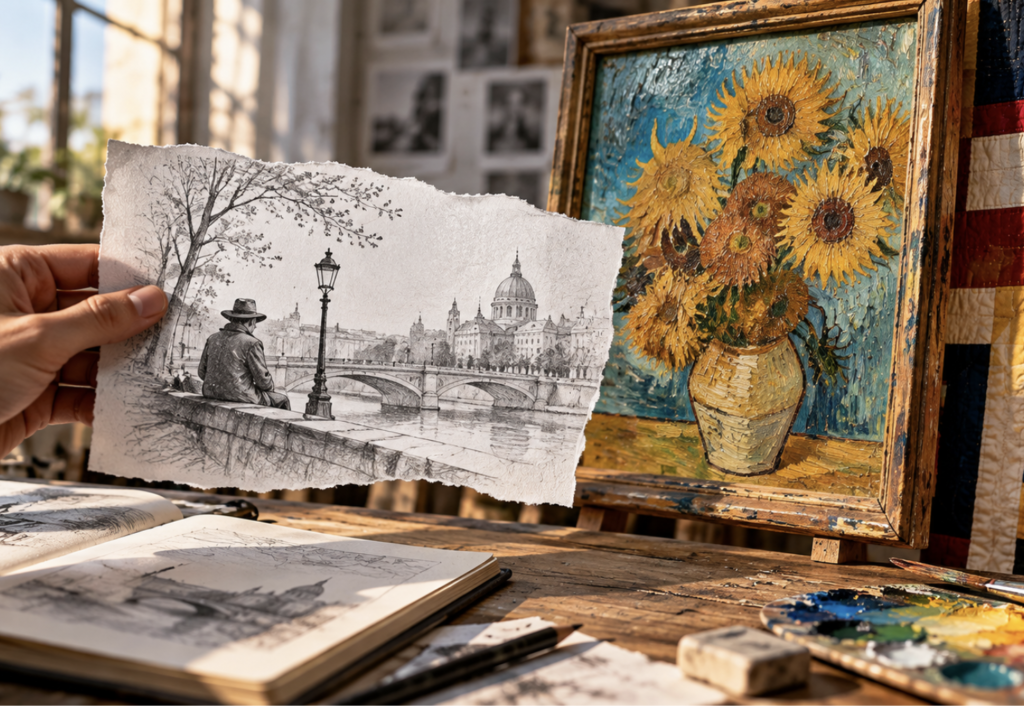
The Smudge Is Sometimes the Point
Robert Rauschenberg erased a drawing by Willem de Kooning in 1953 and turned the remaining traces into a museum work. Ben Heine began combining pencil drawings with photographs in 2010. A worn scrap of fabric can become the center of a Gee’s Bend quilt. In each case, viewers see the maker’s choices in a mark that a polished reproduction might remove.
Artistic imperfection is not the same as carelessness. A deliberate erasure, a visible brush ridge and an uneven fabric strip carry evidence of revision, pressure or material limitations. The useful question is what would disappear if every irregularity were corrected.
Rauschenberg Made an Artwork by Taking Marks Away
The San Francisco Museum of Modern Art owns Rauschenberg’s Erased de Kooning Drawing, dated 1953. Willem de Kooning agreed to provide a drawing after Rauschenberg asked to use it for an experiment in erasure. Jasper Johns later helped prepare the label and frame that make the action intelligible to a viewer.
In 2010, SFMOMA’s infrared imaging highlighted heavier charcoal and graphite traces. Fainter lines, shading and other media remain unrecoverable, so the image documents evidence of the erasure rather than recreating de Kooning’s complete original.
Ben Heine’s Pencil Interrupts the Camera’s Certainty
Belgian artist Ben Heine dates his Pencil Vs Camera concept to April 2010. He places a hand-drawn scene in front of a photographed setting and uses the overlap to invent a new reality. Pencil edges, paper texture and deliberate mismatches reveal where the imagined object enters the picture.
To assess one of Heine’s works, look at where the edge of the paper meets the photographed background. Pencil line weight and deliberate misalignment identify the boundary between invention and the camera’s recorded scene. A perfectly blended composite would conceal precisely that decision.
Gee’s Bend Quilts Turn Reuse Into Design
The National Gallery of Art acquired nine Gee’s Bend quilts among a larger group of works from the Souls Grown Deep Foundation in 2020. Mary Lee Bendolph’s Blocks and Strips, dated 2002, combines wool, cotton and corduroy into a geometric composition. The work uses discarded textiles rather than identical factory-made patches.
Bendolph’s wool, cotton and corduroy patches come from materials with different textures and histories. Read the spacing of the blocks and strips as compositional choices, not defective attempts at identical units.
Van Gogh’s Brush Ridges Record Movement
Vincent van Gogh painted The Starry Night in June 1889 in Saint-Rémy. The Museum of Modern Art describes short brushstrokes and thick applications of paint that create visible surface movement. MoMA also explains that the village was not visible from Van Gogh’s window, and that he painted the night scene in daylight over several sessions. Those details challenge the idea that expressive brushwork is simply an uncontrolled record of what his eyes saw.
Thick impasto records the tool’s movement; the invented village and arranged cypress show deliberate construction. In a flat reproduction, compare MoMA’s close-up and interpretive materials before treating visible color as the whole work.
A Game’s Random Result Is Not an Artist’s Rough Edge
Digital slot animations can borrow hand-drawn outlines, distressed textures and exaggerated motion to establish a particular visual mood. Their appearance tells players how the interface wants a moment to feel; it does not determine the outcome of a spin. The UK Gambling Commission’s technical standard RTS 7 requires acceptably random outcomes in regulated remote games.
An illustrated reel may look spontaneous even when its behavior is specified in code. The presentation layer uses animation while result logic follows the game’s technical rules. A casino betting app can display animated symbols and sound cues while game results are determined by an RNG and a published paytable. Return-to-player percentages describe long-run theoretical distributions, not the amount a particular player will receive in one session. Artistic irregularity changes interpretation; regulated game randomness governs outcomes.
Sports Odds Need Numbers Rather Than Visual Intuition
A scorer’s handwritten line and an official result serve different purposes. A sketch communicates emphasis; an odds quote expresses a price for a defined sporting outcome. An apparent 50–50 match is not necessarily priced at decimal 2.00 for both sides once bookmaker margin is included.
Advertising images can make a price look authoritative without identifying a regulator. App-store visibility says little about which jurisdictions permit staking money. Fans comparing best sports betting sites in India should not treat a colorful app design as evidence that the underlying service is authorized. India’s Promotion and Regulation of Online Gaming Act, 2025 prohibits online money games and their promotion, with implementing rules taking effect on May 1, 2026. The legal status of money gaming cannot be inferred from an app icon.
Three Tests Before Removing the Irregularity
Artists and designers deciding whether to clean a drawing can ask three concrete questions:
- Does the mark reveal a material, tool or revision?
- Does the irregularity guide attention or obscure essential information?
- Would removing the mark make this work indistinguishable from another?
A visible correction may be appropriate in a sketchbook or textile, but a confusing payment amount or unclear game rule needs precise labeling. Museum conservation also separates documentation from recreation: SFMOMA’s infrared reconstruction exposed traces without pretending to recover de Kooning’s complete composition. The strongest imperfect detail changes what the audience understands.

























0 Comments on "Why Imperfect Art Works: Ben Heine, Van Gogh and the Mark of a Hand"
Would you like to share your thoughts?
Your email address will not be published. Required fields are marked *