
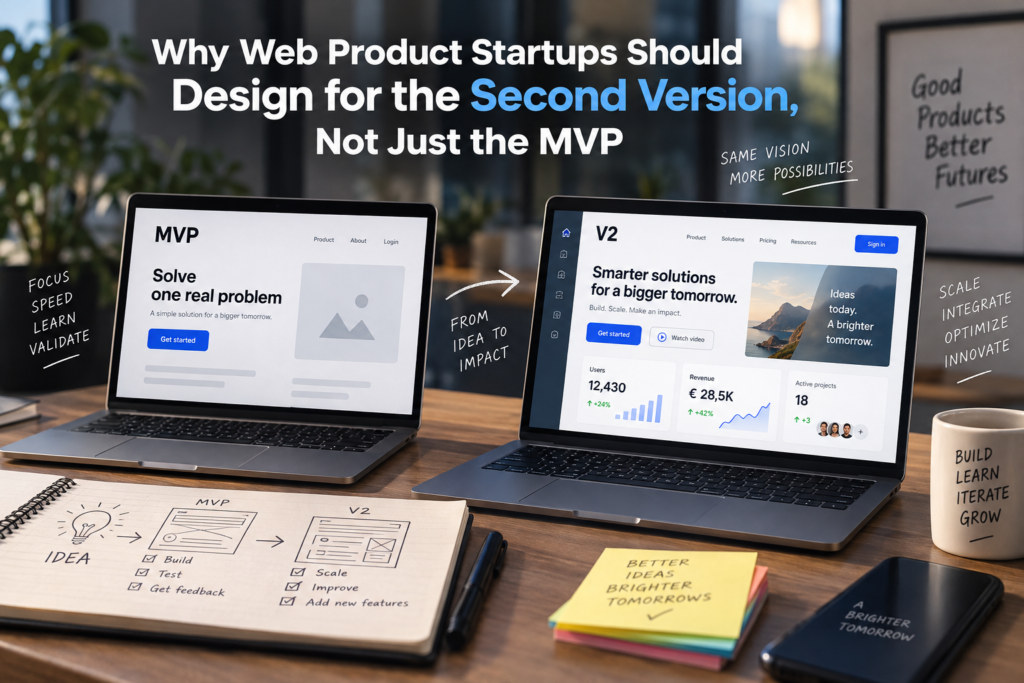
A web startup usually begins with a simple objective: get something useful in front of customers quickly. That urgency is healthy. Problems begin when “move fast” becomes permission to make technical decisions that become expensive as soon as the product gains traction.
Strong early-stage products are not engineered for imaginary millions of users, but they are built so change remains possible. Founders need technology that supports experiments, integrations, new workflows, and future features without turning every release into a rescue mission. For a startup, the real technical advantage is not complexity. It is the ability to keep shipping as the business learns.
Choose a Stack That Supports Fast Learning
The first technology decision should reflect how the startup expects to learn. An MVP will change repeatedly as customers reveal which assumptions were wrong, so developer productivity and maintainability often matter more than architectural novelty.
For founders considering established web frameworks, working with a Ruby on Rails development company can make sense when the product needs to move from an MVP into a production application without immediately rebuilding its foundations. Rails can support custom web applications, APIs, payment integrations, background processing, and products expected to evolve over time.
That does not mean every startup needs the same framework. The useful question is whether the stack lets a small team build, test, deploy, and revise important features without unnecessary friction.
Build the MVP Around One Expensive Problem
Startups often overload their first release because founders want the product to look substantial. They add dashboards, elaborate profiles, notifications, multiple user roles, and settings before confirming whether customers care about the core outcome.
A better MVP attacks one costly or frustrating problem unusually well.
Fewer features also mean fewer assumptions encoded into the product. Developers can observe real behavior before creating abstractions for workflows that may never matter. Define the central user action, build the shortest credible path to it, and measure how customers use it.
This gives the startup something more valuable than an impressive feature list: evidence. Once founders know which part of the product customers repeatedly use and value, later development decisions become much easier to prioritize.
Treat the Database as Product Infrastructure
Interfaces change quickly. Data tends to stay.
A rushed database design can become a stubborn constraint as a web product grows. Duplicate records, ambiguous relationships, and missing historical information may seem harmless with 100 users but become dangerous when the company needs reporting, integrations, migrations, or compliance controls.
Founders do not need an elaborate enterprise data model on day one. They do need clarity about what information represents, which records must remain historically accurate, and who can access particular data.
Its value appears later, when the startup can add features without first untangling years of contradictory information. This becomes particularly important for marketplaces, subscription platforms, financial products, healthcare applications, and software serving multiple organizations from the same platform.
Make Third-Party Integrations Replaceable
Modern web products depend heavily on external services. Payments, email, analytics, maps, messaging, identity verification, search, accounting, and AI may all come from outside providers.
These integrations accelerate development, but they also create dependencies. A startup should avoid scattering provider-specific logic throughout the application. Important integrations need clear boundaries so a vendor can be upgraded or replaced without rewriting unrelated features.
This matters when pricing, reliability, geographic coverage, or product requirements change. The goal is not instant interchangeability. It is preventing a convenient early decision from becoming permanent architectural captivity.
Founders should also document why important providers were chosen. Future developers can then understand whether an integration exists because of price, functionality, compliance requirements, or simply because it was the fastest option available during the MVP.
Add AI Where It Removes a Real Bottleneck
Investors and customers increasingly expect startups to have an AI story, but adding a chatbot to the navigation bar is not a product strategy.
AI earns its place when it removes a specific bottleneck. A support platform might summarize long conversations before an agent responds. A document product could extract structured information from files. A marketplace could improve search by interpreting natural-language intent.
The surrounding architecture matters too. Production AI features can require model APIs, retrieval systems, vector search, function calling, monitoring, fallback behavior, and controls for sensitive information. Rails applications, for example, can connect with major AI providers or self-hosted models and support vector-search architectures.
Start with a measurable task. If AI cannot improve speed, quality, cost, or customer experience in that workflow, it probably does not belong in the product yet.
Prepare for Scale by Measuring Before Rebuilding
Growing startups eventually encounter slow pages, expensive database queries, overloaded background jobs, or infrastructure costs that rise faster than revenue. The instinctive response is sometimes a major rewrite.
Measurement should come first.
Track response times, database performance, error rates, background jobs, and infrastructure use. Find the actual bottleneck before changing the architecture. Improvements may involve fixing inefficient queries, adding indexes, improving caching, or moving slow work into background processing. These are among the approaches used when optimizing high-traffic Rails applications.
A monolithic application is not automatically a scalability failure, just as microservices are not automatically sophisticated. Architecture should become more complicated only when workload, reliability requirements, or the organization itself genuinely requires it.
That discipline can save a startup from spending months rebuilding infrastructure when the real problem might be a handful of inefficient database queries.
Keep Security in the Product Roadmap
Security becomes harder to retrofit after customers, integrations, and sensitive records accumulate. Sensible practices should begin while the system is still small.
Authentication, authorization, dependency updates, backups, secrets management, logging, encryption, and access controls deserve early attention. Products entering regulated sectors may later require audit trails and more formal compliance work.
Security should evolve with risk. A consumer prototype does not need every control of a mature financial platform, but founders should understand what changes when enterprise customers request SOC 2 assurance, healthcare clients introduce HIPAA requirements, or payment workflows create additional obligations. Security and compliance work for production web applications can include vulnerability remediation, dependency monitoring, authentication reviews, and audit-trail implementation.
Making security part of normal development is generally easier than stopping product work later to address years of accumulated weaknesses.
Design Maintenance Into the Funding Plan
Founders naturally budget for new features. They are less enthusiastic about work that keeps existing features healthy.
Production software continuously creates maintenance obligations. Framework versions age, dependencies require updates, APIs are deprecated, infrastructure changes, and shortcuts accumulate as technical debt.
The financial plan should reserve engineering capacity for upgrades, monitoring, testing, documentation, performance work, and refactoring. Waiting until maintenance becomes an emergency usually makes it more expensive.
Incremental modernization can also be safer than postponing upgrades until the only apparent option is a risky rewrite. Existing Rails applications, for example, can be modernized through phased upgrades intended to keep production systems running while technical improvements are introduced.
The most valuable startup architecture is ultimately organizational as well as technical. Founders, product managers, designers, and engineers need a shared understanding of what is being tested and why.
Short feedback loops help. Release smaller changes, observe behavior, talk to customers, and revise. Automated tests and deployment pipelines can make that rhythm safer by reducing manual work around releases.
A startup cannot know exactly what its product will look like three years after launch. New customer groups may emerge, pricing may change, AI may reshape a workflow, or an enterprise contract may introduce requirements nobody anticipated during the MVP.
That uncertainty is the nature of building a web product. A focused MVP, thoughtful data model, controlled integrations, measured scaling strategy, sensible security, and regular maintenance all serve the same purpose: keeping tomorrow’s options open.
For a startup, that flexibility can matter more than any single framework or feature. The technology has done its job when the company can learn something important from customers and still ship a thoughtful response while the opportunity matters.




























1 Comment on "Why Web Product Startups Should Design for the Second Version, Not Just the MVP"
Would you like to share your thoughts?
Your email address will not be published. Required fields are marked *