
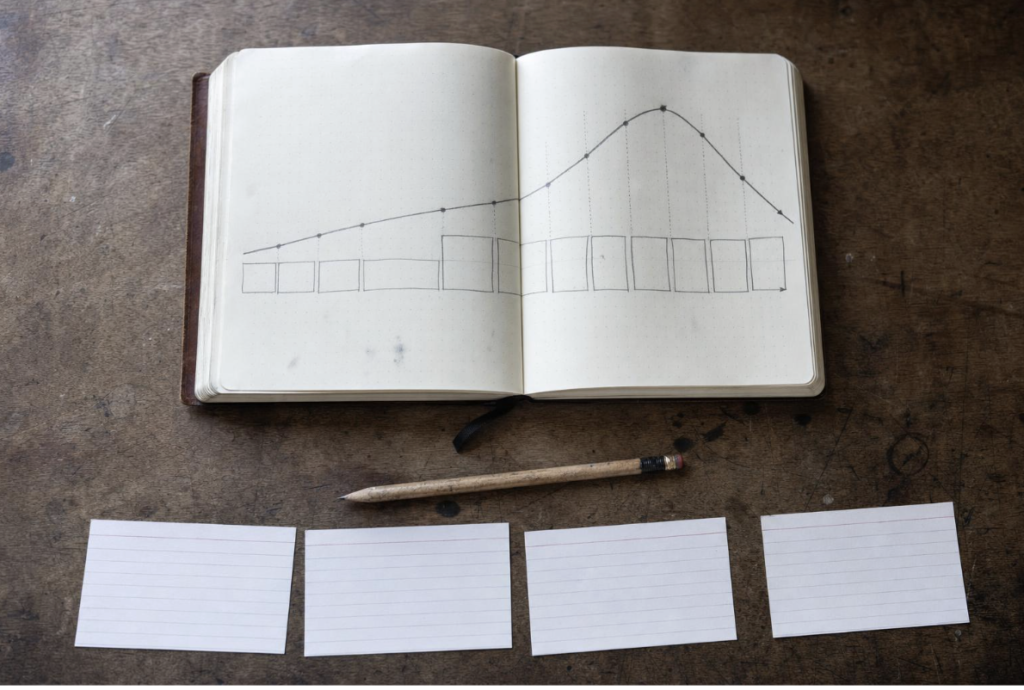
Most satisfying stories share a quiet quality: something changes, and that change feels earned. The story arc traces this path. Understanding how arcs work can help you manage pacing as well as plot. It shows you where to apply pressure, where to give a character room to reflect, and where the story must turn. Here is how an arc works, how common frameworks approach it, and how to map one before you draft.
What a Story Arc Actually Is
A narrative arc is the overall path a story follows from beginning to end. It is commonly described through five elements: exposition, rising action, climax, falling action, and resolution. Exposition establishes the world and its ordinary state. Rising action introduces pressure. The climax delivers the decisive turn. Falling action explores the consequences, and the resolution settles the story into a new normal.
The useful distinction is that an arc tracks change rather than isolated incidents. Two novels can contain similar events yet produce different experiences based on how those events are arranged. For a compact explanation of these components, the Literature & Latte blog provides helpful background on story arcs and narrative structure, including plot progression, character development, and subplots.
Arc, Plot, and Character Arc Are Not the Same Thing
Plot is the sequence of events: a woman loses her job, moves home, and reopens her father’s shop. The narrative arc arranges those events so they build momentum and meaning. The character arc is the internal transformation beneath them: the same woman moves from trying to prove herself to defining success on her own terms.
Character arcs often resolve as the narrative arc moves toward its conclusion. The external problem is settled, and readers see who the person has become. Keeping plot, narrative arc, and character arc separate in your outline makes revision easier. You can identify whether a flat chapter has an event problem, a structural problem, or a character problem.
Frameworks You Can Borrow
No framework is required, and this list is not exhaustive. Think of each model as a different way to answer the same question: How does tension build, and how does it release?
- Three-act structure: Divides a story into setup, confrontation, and resolution. It is widely used in fiction and screenwriting.
- Freytag’s pyramid: Uses a five-part model of exposition, rising action, climax, falling action, and resolution.
- The Hero’s Journey: Traces departure, trials, and return across a series of stages. It often suits quest and coming-of-age stories.
- Kishōtenketsu: Uses four parts: introduction, development, twist, and resolution. Because it does not depend on central conflict, it can suit quiet, observational, or slice-of-life stories.
These frameworks often describe overlapping patterns. Choose the simplest model that helps you see the story clearly rather than trying to satisfy every beat in a formula.
Map Your Core Arc in One Sitting
Set aside about 45 minutes and create a one-page map. Keep it short enough to review at a glance.
- Name the change. Write one sentence describing what should be different by the final page, both for the character and the reader.
- Establish the beginning. Describe the status quo, then identify the inciting incident that makes it impossible to maintain.
- Build the middle. List three escalating complications and one midpoint shift where the character’s goal or understanding changes.
- Set the ending. Define the climax as a decision rather than only an event, then note the consequences and cost.
- Summarize each stage. Give every stage a plain, one-sentence description. If a sentence is hard to write, that part of the arc may need more thought.
Index cards, a one-page beat sheet, or a rough chapter outline can all work. To understand story arch and narrative structure, use the Literature & Latte article as background reading while comparing your map. Digital outliners and virtual corkboards make rearranging ideas easier, but the medium matters less than being able to see the whole shape at once.
Subplots, Character Change, and Pacing
Connect each character’s want, meaning what they chase, and need, meaning what they lack, to the main arc. Add one or two subplots that reinforce the theme or challenge it. Literature & Latte’s guide to narrative arcs makes a useful point: subplots should contribute to the main narrative rather than distract from it. Test a subplot by asking whether removing it would change a major turning point. If nothing important moves, cut or combine it.
Pacing follows from the same map. A midpoint reversal can keep the middle from drifting, while pinch points remind readers what the opposing force can do. The climax should arrive late enough for the earlier pressure to feel earned but leave enough space for meaningful consequences and resolution.
Build Mini-Arcs Within Scenes
Scenes also rise and fall in miniature. Ask four questions: What does the point-of-view character want in this scene? What stands in the way? What changes? What is different by the end? The same compression happens well outside fiction, and writing on story arcs in video shows how a thirty-second spot still needs a setup, an obstacle and a resolution to hold attention. If none of the answers affects the larger story, the scene may need a stronger purpose.
Vary the intensity deliberately. Three high-pressure scenes in a row can feel as flat as three quiet scenes because the reader has no contrast. A reflective scene after a major setback can reveal consequences while preparing the next turn.
Common Problems and Simple Fixes
- Front-loaded exposition: Introduce necessary facts through action or conflict so information arrives while something is at stake.
- An aimless middle: Define a midpoint reversal and make each preceding scene move toward it.
- Unrelated subplots: Remove them or connect them to a turning point in the main arc.
- A weak climax: Give the central character a meaningful choice that affects the outcome.
- An ending that does not pay off: Revisit the question or tension established in the opening pages.
Where to Start
Choose one framework and draft a one-page beat map. Then identify three scenes that move the arc forward. Background resources such as the Literature & Latte article on story arcs are often most useful during planning or revision, when you can compare the model with the story in front of you. Structure is a guide, not a substitute for drafting.
FAQ
These brief answers address common questions that come up when writers begin outlining story arcs.
What is the difference between a story arc and a plot?
Plot is the sequence of events in a story. The narrative arc arranges those events so they build momentum and meaning. You can keep the same plot points and create a different arc by reordering them or changing where the pressure peaks.




























3 Comments on "How to Understand Story Arcs and Create a Strong Narrative Structure"
Would you like to share your thoughts?
Your email address will not be published. Required fields are marked *